
What is unprop.?
Your own on-chain vault: investors deposit, you trade from your broker, and third parties verify the numbers.
In short
unprop. gives traders and fund managers their own on-chain vault. Investors deposit into it, you trade it from the broker or exchange you already use, and independent providers verify the numbers. It is the infrastructure of a fund, live in about a week, with no setup fee.
In 30 seconds
- Your vault, with your name, your fees and your terms.
- Investors deposit USDT, USDC, BTC or ETH and receive vault shares.
- You trade from your broker or exchange. You can’t withdraw investors’ money.
- Renesis, 1Token and Chainlink verify NAV and reserves on-chain.
- $0 setup. Charge 2/20, keep 1/18.
Who it's for
You trade your own book
Start with your own capital and build a track record verified from day one, so the next investor doesn't have to take your word for it.
You manage money for others
Give your current investors a vault they can check, and let new ones find you.
Not a fit
If you want someone else's capital to trade without investors of your own, that is what prop firms sell.
How it works
Launch
Your vault, your fees, your terms. Live in about a week after KYC.
Prove
Third parties verify NAV and reserves, so your track record is public and checkable from day one.
Get distributed
Your vault is listed on DeFi protocols, marketplaces and fintech earn apps. Top performers get capital introduction and placement agents.
Go institutional
Add a regulated BVI fund when institutions want to invest.
Where the money sits
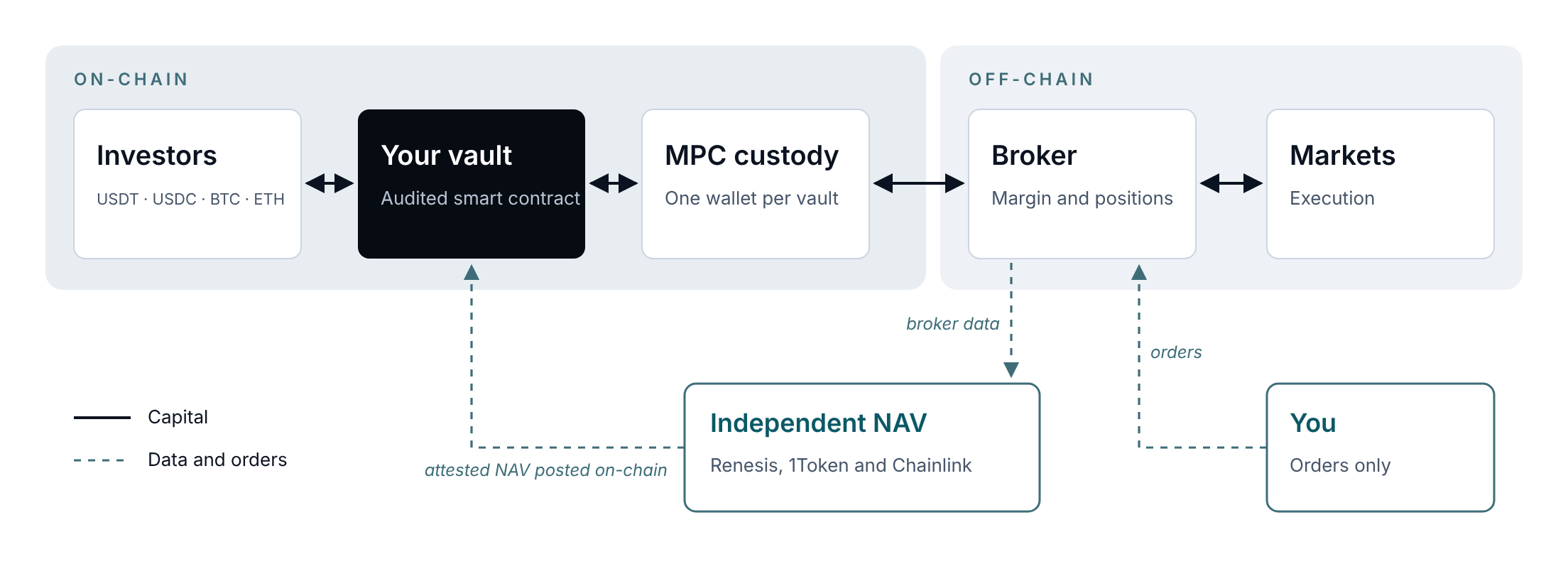
How the money moves, step by step
Investors deposit
USDT, USDC, BTC or ETH go into the vault's smart contract, built on Enzyme Onyx. It issues vault shares (ERC-20 tokens) at the current share price.
The vault funds its MPC wallet
Assets move to the vault's own MPC wallet. Signing keys are split, so no single party, including unprop., can move them alone.
The wallet funds the broker
The MPC wallet funds the vault's account at the broker or exchange. Money in that account can only go back to the vault's wallet.
The manager trades
The manager sends orders to the broker and trades the account like their own book, with no way to withdraw.
NAV is verified
Renesis, 1Token and Chainlink read positions and balances from the broker, compute NAV and post the attested figure on-chain. Chainlink CRE proves the reserves exist.
Shares are priced
Onyx applies the vault's fees to the attested NAV and sets the new share price that investors see.
Investors redeem
On the vault's terms, money comes back from the broker to the MPC wallet and the vault, and out to the investor's wallet.
Who does what
- You set the strategy, fees and vault terms, and send orders to your broker. You can’t withdraw or move investors’ money.
- Investors deposit, redeem on the vault’s terms and see verified NAV. They never see your positions.
- MPC custody holds each vault’s assets in its own wallet. Signing keys are split, so no single party can move funds.
- Your broker or exchange executes orders and holds margin and positions.
- Independent NAV providers (Renesis, 1Token and Chainlink) read broker data, attest NAV and prove reserves on-chain.
- unprop. runs the vault software, onboarding and distribution. It doesn’t trade, advise, use your signals or guarantee capital or returns.
What it costs
$0
No setup fee, no challenge fee.
$100 a month
Only while your vault is under $100K. It stops after that.
Keep 1/18
unprop. takes 1% of AUM and 10% of your performance fee. Charge 2/20, keep 1/18.
Your edge stays yours
What unprop. is not
- Not a prop firm. No challenge fee, no simulated account, no payout split.
- Not a fund. Your vault isn’t a regulated fund. When institutions need one, you add a BVI fund.
- Not your investment manager. unprop. doesn’t trade, advise, or guarantee capital or returns.
- Not a bank. Vault shares aren’t deposits and aren’t insured.
Keep reading
- Launch a vault: what you need and how long it takes.
- Pricing: what unprop. costs at $100K, $500K and $5M.
- Custody and your IP: who holds what, and what investors can see.
- unprop. vs a prop firm vs your own fund: cost, time and who owns the record.